How to practise safety play (with a target you can score)
Almost nobody practises safety, and the reason is structural: on your own there is no opponent to leave in trouble, so there is nothing to succeed or fail at. You play a defensive shot, it goes somewhere, and you have learned nothing.
The fix is to replace the opponent with a target zone. The shot passes if the cue ball finishes inside the zone and fails if it does not — which turns safety into something you can actually score.
How a Safety card works
The shaded area is the target. Play your shot legally and the cue ball has to come to rest inside it — the card says so in as many words at the bottom: Cue Ball must end in the zone.
That perimeter band above is the gentlest version. It encodes the most basic safety instinct there is: get the white near a cushion, where it is awkward to play from, rather than sitting in the open where anything is possible.
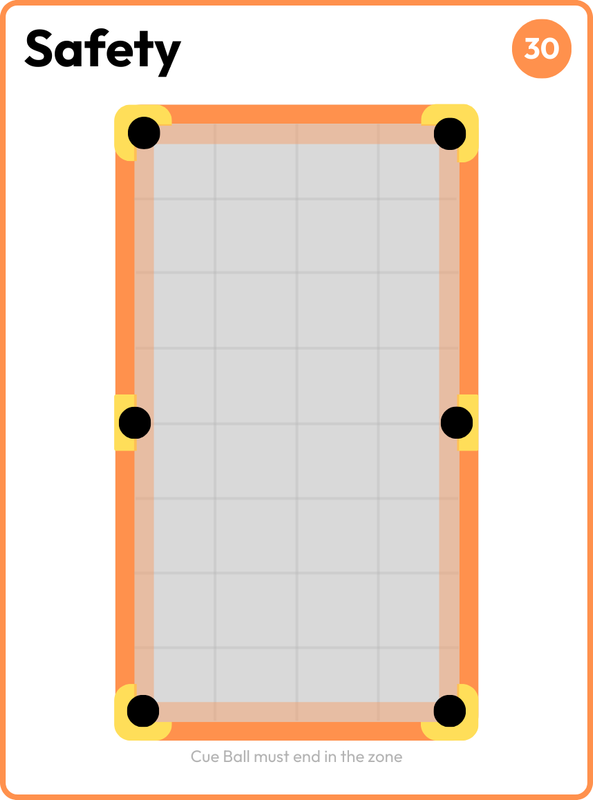
The easiest zone in the deck — anywhere near a cushion counts.
Why a zone is a fair substitute for an opponent
A good safety is not really about hiding the cue ball behind something. Most of the time it is about where the cue ball stops — tight to a rail, a long way from the object balls, at an angle that makes the next shot uncomfortable.
Those are all positional outcomes, and a zone measures positional outcomes exactly. You are not simulating the whole tactical picture, but you are training the physical skill the tactic depends on: putting the white where you meant to, softly, at distance.
Start with a whole rail
A full-rail band is the right place to begin. It is a big target, so you are only being asked to control direction and rough weight, not precision.
The half-rail version is the first real step up. Now the zone has a length as well as a side, so getting the white to the correct rail is no longer enough — it also has to stop in the right part of it. That is pace control, and pace is what most safety errors actually come down to.
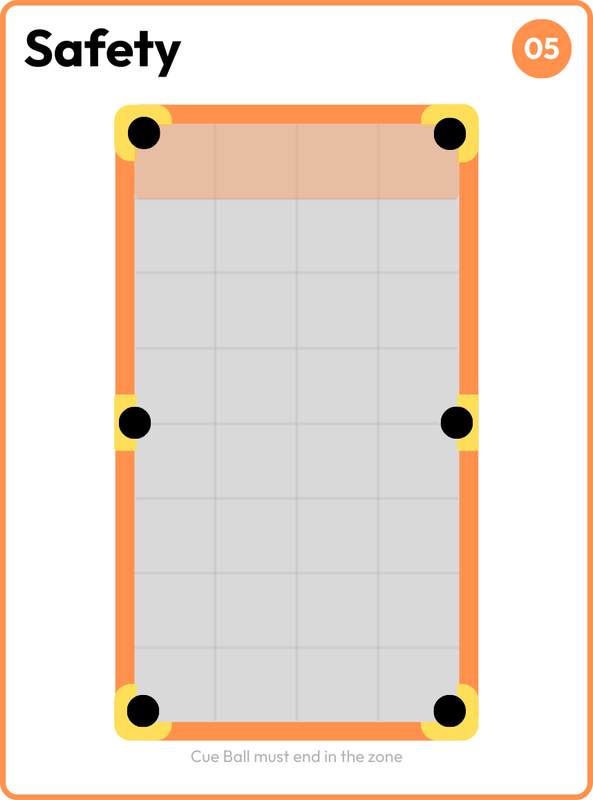
The full top rail — a wide, forgiving strip.
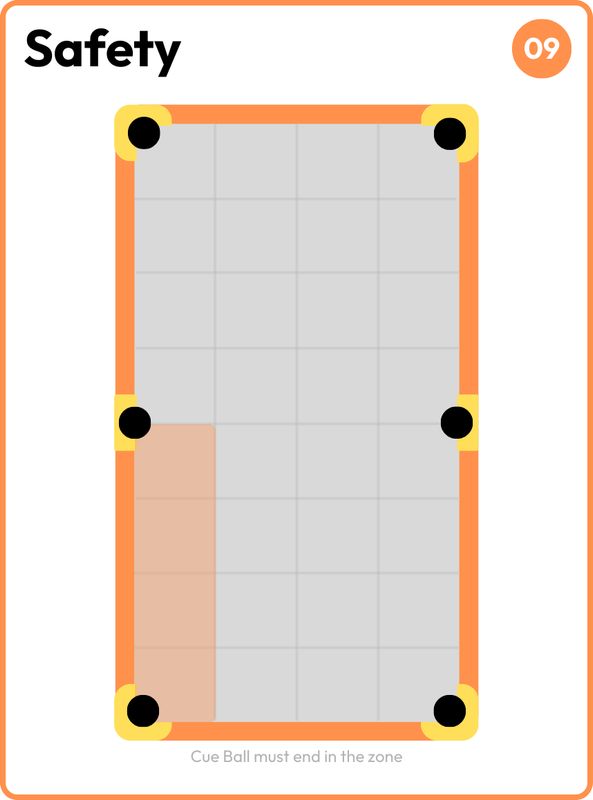
Half a side rail — still generous, but now it has a length.
Then shrink the target
A small corner zone asks for both the right line and the right distance, with no margin in either. Sending the cue ball the full length of the table and stopping it in a two-cell box is a genuinely hard shot, and it is the shot that wins frames when neither player can pot.
Do not jump to these. If you cannot hit a full rail eight times out of ten, a corner zone will just produce a lot of noise and very little learning.
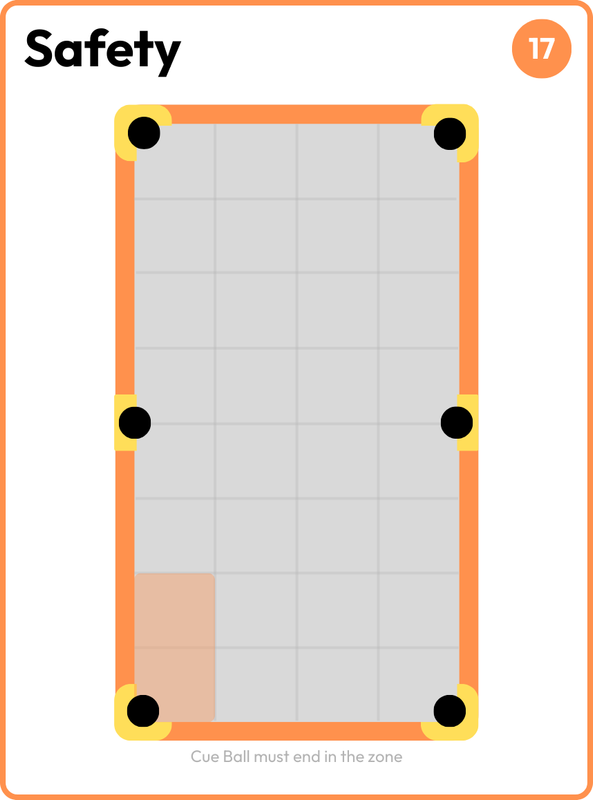
A corner pocket zone — precise length required.
A safety session that works
That last point is the same principle as everywhere else in practice: varying the task is what makes the skill transfer. See blocked vs random practice for why repeating one safety over and over flatters you in the session and does very little afterwards.
- Set any easy layout on the table so there are balls to be legal against.
- Draw a safety zone — or let the app deal one — and play one attempt.
- Record pass or fail. Do not retake it.
- Change the zone and go again. Ten attempts across ten different zones beats ten attempts at the same one.
The two errors that dominate
- Too much pace. Far and away the most common. A safety that overruns the zone by a foot has usually been hit twenty percent too hard, not aimed wrongly.
- Forgetting to stay legal. A beautiful leave that fouls is a free ball for your opponent. Contact your own ball first, every time, even in practice.
Common questions
- Can you practise safety play without an opponent?
- Yes, if you replace the opponent with a scoreable target. A defined zone the cue ball must finish in gives you a pass or fail, which is what practice needs and what free-form defensive shots lack.
- Is safety practice worth it for a casual player?
- It is arguably the best return on time available. Most amateurs have never practised it at all, so improvement comes quickly — and it decides frames where potting alone is level.
- What is a good safety success rate?
- Against a full-rail zone, aim for eight in ten before shrinking the target. Against small corner zones, four or five in ten is a respectable standard.
Stop choosing your own drills
CueCards deals you a randomised drill at your level, tracks whether you made it, and moves your skill rating accordingly. Free to start, no ads.
Deal a drill