Playing around obstacle balls
In a real frame roughly half the balls on the table are not yours, and they do not move out of the way. Practising on an empty table with only your own balls trains a game you never actually play.
The Obstacle Balls pack fixes that by putting balls on the table that you must work around and must not pot.
How obstacle cards work
Red dots are the balls you pot. Blue dots are obstacles — they stay on the table, they block lines, and potting one is a fail.
Both cards above are the gentlest in the pack: the blues sit wide and rarely interfere with a sensible route. That is the point of starting here — you learn to notice the obstacles before you have to fight them.
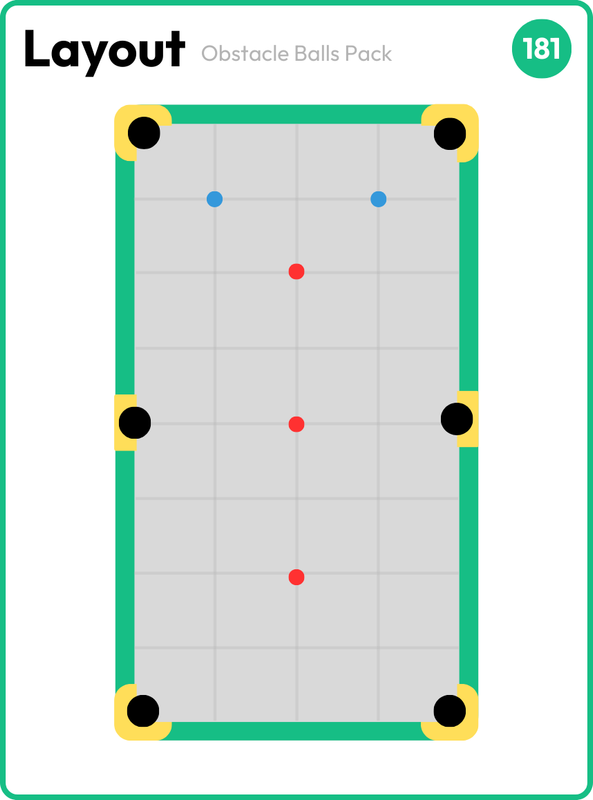
Red to pot, blue to avoid.
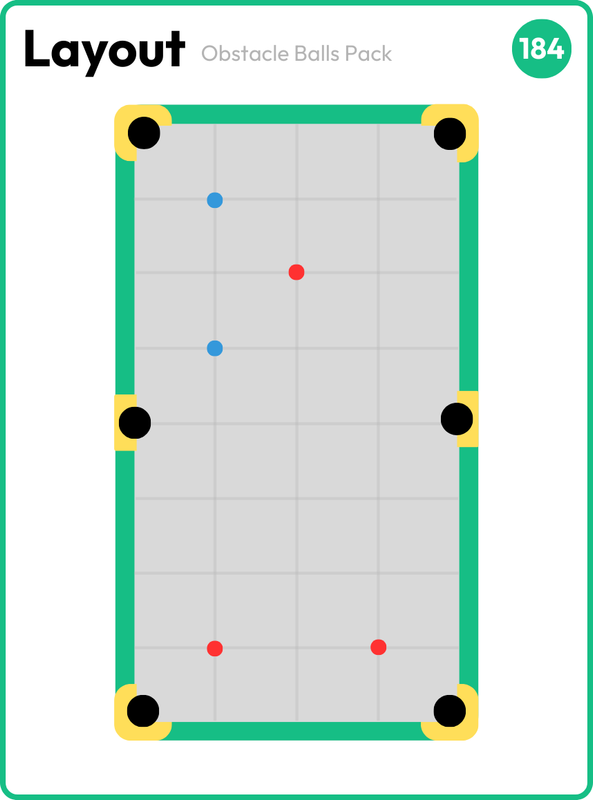
Blues stacked on one side, reds kept clear.
The three problems obstacles create
That middle case is the reason to practise with obstacles at all. On an open table you can send the cue ball anywhere; with three dead balls in the middle, half your routes are gone and you have to find the other half.
- The pot is blocked. Nothing to do but pick a different ball, or bank around it.
- The pot is fine but the cue ball route is blocked. Far more common, and much easier to miss until you are already down on the shot.
- Both are fine but the next position is blocked. The one that catches good players out, because it only appears one shot later.
Route around, not through
The default fix for a blocked cue ball route is a cushion. Going into a rail and out again takes the white around an obstacle where a direct path would clip it, and it does so with much better speed control than trying to thread a gap.
The second fix is choosing a different angle on the current ball. A thicker or thinner contact changes the tangent line, which changes the whole route — see cue ball control.
Why this is the most transferable practice there is
An open-table run teaches you pattern play in ideal conditions. An obstacle layout teaches you pattern play in the conditions you actually meet, where the tidy route is unavailable and you have to find the second-best one.
It is also the closest a solo drill gets to the feel of a real frame, because the obstacles do the job an opponent's balls would.
Common questions
- What are obstacle balls in CueCards?
- Balls shown in blue on a Layout card. They stay on the table for the whole drill, block lines, and must not be potted — the same role your opponent's balls play in a frame.
- Should beginners practise with obstacle balls?
- Once you can clear a simple open layout. Obstacles add a decision layer rather than a technical one, so they are most useful when potting is no longer the limiting factor.
Stop choosing your own drills
CueCards deals you a randomised drill at your level, tracks whether you made it, and moves your skill rating accordingly. Free to start, no ads.
Deal a drill