How to break up clusters without wrecking the table
A cluster is two or more balls touching or close enough that neither has a clear route to a pocket. Left alone it will still be there at the end of the frame, which is when it will cost you.
The skill is not hitting it hard. It is choosing when, and setting up the shot before so the break-out costs you nothing.
What a cluster looks like on a card
Both of these are from the Clusters pack and both are deliberately mild: a single problem area with plenty of open table around it. That is the right place to learn the skill, because you get to practise the break-out without also being punished for everything else.
The first has a genuinely frozen pair at the table centre. The second has two loose pairs, which are easier — a loose pair often only needs nudging a few inches to open both balls up.
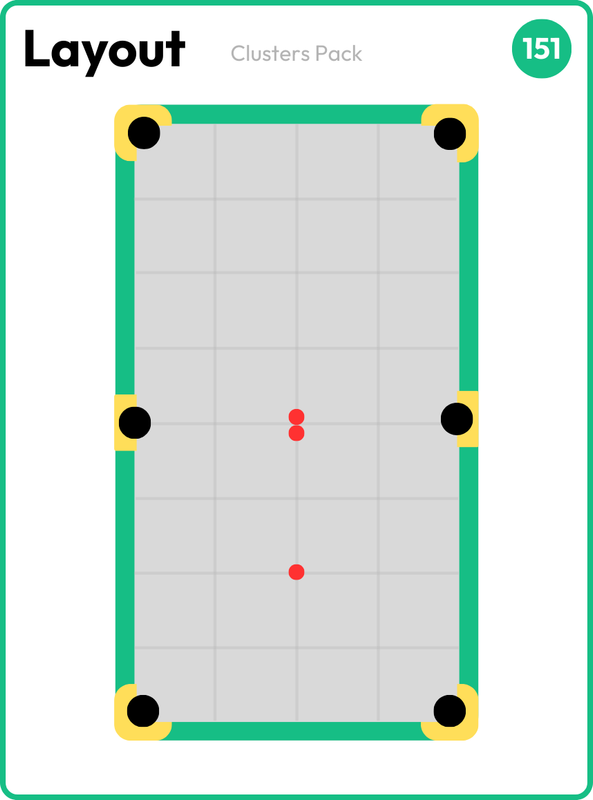
One frozen pair, everything else open.
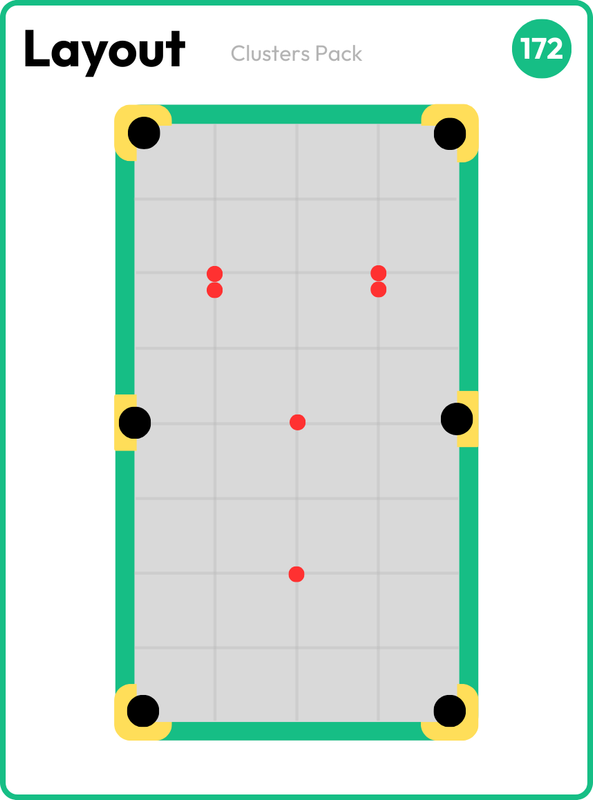
Two loose pairs — the gentlest cluster card in the deck.
Break out early, not late
The instinct is to leave the awkward balls until last and hope. This is backwards. Early in the run you have plenty of other balls to fall back on if the break-out leaves you badly; at the end you have none.
The rule of thumb: deal with the cluster while you still have at least two easy balls in reserve as insurance.
The shot before matters most
A break-out is rarely a shot of its own. It is a normal pot where the cue ball happens to continue into the cluster afterwards — which means the shot that gets you into position for it is the one that decides whether it works.
You want to arrive with an angle that sends the cue ball into the cluster at the right speed and from the right side, and with the cue ball ending up somewhere useful afterwards. Plan two shots back, not one.
How much pace
- Less than you think. A cluster only needs to separate enough for one ball to have a pocket. Balls a few inches apart are solved.
- Nudge, do not scatter. Big pace sends balls to cushions, and rail balls are their own problem.
- Protect the rest of the table. A break-out that also disturbs your two easy insurance balls has taken away the thing that made it safe to attempt.
A drill for it
Set one of these cluster layouts, or any layout with a frozen pair, and give yourself a simple pass condition: clear all the balls, and you must break the cluster out before only two balls remain.
That extra condition is what forces the skill. Without it you will keep leaving the cluster to the end, which is exactly the habit the drill exists to break.
Common questions
- When should you break up a cluster in 8-ball?
- Early, while you still have easy balls in reserve to recover with. Leaving it to the end means attempting the hardest shot on the table with no safety net.
- How hard should you hit a cluster?
- Only hard enough to separate the balls by a few inches. Extra pace mostly sends balls onto cushions and disturbs the rest of your position.
- What if the cluster contains the black?
- Break it out earlier still. A black frozen in a cluster with your last ball is the most common way to lose a frame you were winning.
Stop choosing your own drills
CueCards deals you a randomised drill at your level, tracks whether you made it, and moves your skill rating accordingly. Free to start, no ads.
Deal a drill